
The Jagannath Temple in Puri is a monumental Hindu sanctuary in Odisha, India, primarily dedicated to Lord Jagannath, an avatar of Vishnu. This historic site, rebuilt in the 12th century by the Eastern Ganga dynasty, serves as one of the four prestigious Char Dham pilgrimage destinations. The temple is unique for its wooden deities, which are ceremoniously replaced during the Nabakalebara ritual, and its massive kitchen that produces sacred Mahaprasad. Each year, millions of devotees gather for the Ratha Yatra, a grand festival where the gods are transported on towering, hand-pulled chariots. Beyond its architectural grandeur, the complex represents a profound cultural synthesis of tribal traditions and orthodox Vedic worship. For many practitioners, especially within Gaudiya Vaishnavism, the temple remains a vital spiritual epicenter associated with prominent saints and philosophers.
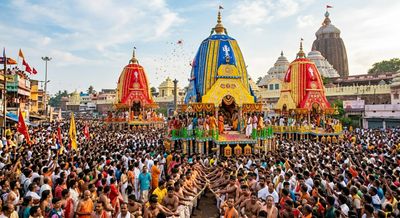
The Ratha Yatra, or chariot festival, is one of the most culturally significant events at the Jagannath Temple in Puri, serving as a powerful symbol of social equality, religious synthesis, and public devotion. Its cultural significance is defined by several key elements:
Symbol of Social Equality and Universalism
The most profound cultural message of the festival is expressed through the Chhera Pahara ritual. During this ceremony, the Gajapati King of Puri, regarded as the most exalted person in the kingdom, dresses as a sweeper to ceremonially clean the area around the deities and their chariots with a gold-handled broom. This act signifies that under the lordship of Jagannath, there is no distinction between a powerful sovereign and the most humble devotee.
Inclusivity and Public Darshana
While the inner sanctum of the temple is generally restricted to Hindus, the Ratha Yatra brings the deities out onto the Bada Danda (Grand Road). This allows the general public and all devotees to have darshana (a holy view) of Jagannath, Balabhadra, and Subhadra as they journey to the Gundicha Temple. The festival essentially brings the divine to the people, regardless of their status or background.
Synthesis of Traditions
The festival reflects a unique integration of various cultural and religious beliefs:
Historical and Global Impact
The festival concludes with the Niladri Bije, when the deities return to the temple. On this day, a playful cultural tradition occurs where Lord Jagannath must offer rasgulla to Goddess Lakshmi to appease her for not taking her on the journey, granting him re-entry into the temple.
The Jagannath Temple is a masterpiece of Kalinga architecture, characterized by its sculptural richness and curvilinear design. Built primarily of stone, the complex covers over 10 acres and is the tallest temple in Odisha.
Main Architectural Sections
The temple is composed of four distinct structures arranged in a sequence that extends westward in the Rekha Deula style:
The tower of the main temple rises 65 meters (214 feet) above the inner sanctum, dominating the landscape with a silhouette that resembles mountain peaks.
Fortifications and Entrances
The complex is protected by two concentric walls: the outer Meghanada Pacheri, which stands 6.1 meters (20 feet) high, and an inner wall known as kurma bedha.
There are four main gates named after animal guardians:
Sacred Symbols
Several iconic symbols define the spiritual and architectural identity of the temple:
Sacred Materials
Unlike the stone icons typical of most Hindu temples, the principal deities—Jagannath, Balabhadra, and Subhadra—are carved from sacred neem wood (daru). These images are ceremonially replaced every 12 to 19 years during the Nabakalebara ritual, symbolizing the "new body" of the divine.
The Jagannath Temple in Puri features an elaborate system of food offerings and houses one of the largest temple kitchens in the world, known as the Rosaghara.
The Rosaghara (Temple Kitchen)
The temple kitchen is renowned for its scale and strict adherence to traditional practices:
Daily Food Offerings
Offerings are made to the deities six times a day in a ritualized schedule:
Seasonal Exceptions
During the Anavasara period—the fifteen days following the Snana Yatra when the deities are believed to be ill—no cooked food is offered to them. During this time, they are tended to by special servitors known as Daitapatis.
Nabakalebara is a major periodic ritual at the Jagannath Temple in Puri that involves the replacement of the wooden idols of Lord Jagannath, Balabhadra, and Subhadra with new, identical replicas. The term literally translates to "new body".
The following details define the significance and process of this ritual:
Frequency and Timing: The ceremony is not annual; it occurs every 8, 12, or 19 years. It is observed specifically during years when there are two lunar months of Ashadha (when one lunar month of Ashadha is followed by another).
Purpose: Unlike most Hindu temples that use stone or metal icons, the Jagannath deities are carved from sacred neem wood (also known as margosa wood or daru). Because wood naturally deteriorates over time, the idols must be periodically replaced.
The Ritual Process:
The ceremony is an elaborate, month-long process. It involves the installation of the new images and the ceremonial burial of the old images. The old idols are buried within the temple complex at a dedicated site known as Koili Vaikuntha.
Sacred Legend: According to local belief, Lord Krishna’s heart is placed within the wooden idol of Jagannath, serving as the "true" divinity that is transferred to the new body during the ritual.
Scale and Attendance: Nabakalebara is one of the most widely attended festivals in the world. During the 2015 ritual, it was estimated that more than three million devotees visited the temple, and the event's budget exceeded ₹41,000,000 (approximately US$430,000).
The Daitapatis are a special group of servitors at the Jagannath Temple in Puri who are believed to be the descendants of the hill tribes of Odisha. They claim a direct lineage from the original tribal worshippers of the deity, who was initially venerated as Nilamadhava by the Bhil and Sabar communities. Because of this heritage, they are considered to be closely related to Lord Jagannath.
Their duties are unique and become most prominent during specific periods of the temple calendar:
Their role highlights the synthesis of tribal beliefs and formal Hindu worship, as they remain the primary caretakers of the deities during their most "human" moments of illness and renewal.
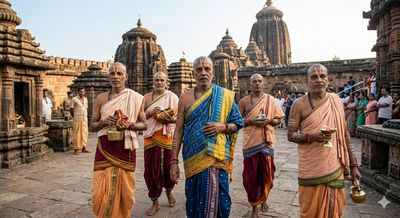
According to tradition, the deities Jagannath, Balabhadra, and Subhadra fall ill every year as a direct result of the Snana Yatra, an elaborate ceremonial bathing ritual.
The legend and resulting tradition involve several key stages:
The deities are believed to be fully recovered just before the start of the Ratha Yatra, an occasion celebrated as Navayouvana, where they are once again presented for public viewing.
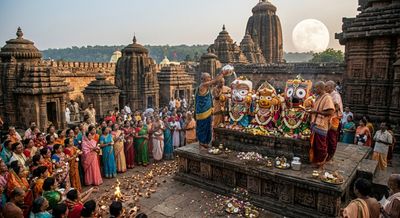
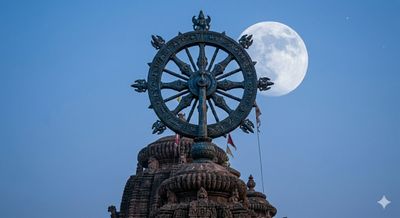
The "mystery" and spiritual significance of the flag atop the Nila Chakra (the blue discus) center on its status as a sacred surrogate for the deities and its rigorous daily ritual.
According to the sources, the following details define its importance:
While the sources describe these sacred traditions and the flag's role in the temple's daily life, they do not explicitly mention the physical "mysteries" often cited in external folklore—such as the flag flying against the direction of the wind or the temple casting no shadow—focusing instead on its ritual significance and its identity as a savior for the "fallen".
Entry into the Jagannath Temple is governed by strict religious and traditional regulations that have existed since the temple's construction.
General Entry Restrictions
Exceptions and Alternatives for Darshan
Because many people are restricted from entering the inner sanctum, the temple provides alternative ways to offer prayers:
Temporary Closures
The legend of Lord Krishna's heart is a central spiritual mystery at the Jagannath Temple, asserting that the physical heart of Krishna resides within the wooden idol of Lord Jagannath.
According to the sources, the legend involves the following key aspects:
This tradition bridges the gap between the mortal and the divine, symbolizing that while the physical "body" (the wooden idol) may perish and be replaced, the divine "soul" (Krishna's heart) remains eternal and is passed down through generations.
The transfer of the divine soul is the spiritual core of the Nabakalebara ritual, a ceremony that literally means "new body" and involves the replacement of the temple's principal wooden idols.
Drawing from the sources and our conversation, here is what happens during this process:
The Jagannath Temple of Puri is not merely a relic of a bygone era; it is a living, breathing mystery that has served as a sentinel of faith on India’s eastern coast for nearly a millennium. Rising 214 feet 8 inches into the salt-laden breeze of the Bay of Bengal, the temple’s main tower dominates the landscape of the "Blue Mountain," or Nilachala. Enclosed by the Meghanada Pacheri, a formidable 20-foot-high fortified wall, the complex feels less like a house of worship and more like a sacred citadel. Completed in 1161 CE, this masterpiece of Kalinga architecture is one of the four Char Dham sites—the cardinal points of the Hindu universe. Yet, beyond its architectural dominance, the temple guards secrets that challenge our understanding of permanence, divinity, and social order.
1. The Gods Who "Change Their Bodies"
In the standard vocabulary of Hindu iconography, divine images are crafted from enduring stone or metal to symbolize the timelessness of the eternal. Puri, however, offers a startling departure. Here, the deities—Jagannath, Balabhadra, and Subhadra—are carved from the wood of the sacred margosa (neem) tree. Because wood is susceptible to the slow decay of time, the deities must undergo a rare and profound ritual of renewal known as Nabakalebara.
Nabakalebara: Translated literally as "new body," this ceremony occurs every 8, 12, or 19 years. It involves the meticulous carving of new idols and the burial of the old images within the temple’s "graveyard," known as Koili Vaikuntha. This cycle of "dying and being reborn" is a powerful philosophical statement. It suggests that while the physical vessel—the wood—is transitory, the "true Jagannath" or the divine essence within (legendarily associated with the heart of Krishna) is eternal. In the quiet of Koili Vaikuntha, the temple reminds us that even the gods submit to the rhythm of renewal.
2. The True Origin of the Word "Juggernaut"
To the Western world, a "juggernaut" is a metaphor for an unstoppable, crushing force. To a resident of Puri, it is a phonetic shadow of Jagannath. The term entered the English lexicon via early European accounts of the Ratha Yatra, where the sheer momentum of the Lord’s massive chariots moved travelers to awe. The scale is truly gargantuan: Jagannath’s chariot stands 14 meters high and 11 meters wide, a wooden behemoth newly constructed each year. Pulled by thousands of devotees along the Bada Danda (Grand Road), the chariot does not move by engine or animal, but by the collective, rhythmic pull of human devotion. While the English word emphasizes a blind, destructive momentum, the local reality is one of "bhakti"—a momentum of the soul that transforms a local festival into a global symbol of overwhelming power.
3. A Kitchen Run by a Goddess
Within the temple walls lies the Rosaghara, the second-largest kitchen in the world. Here, the culinary is inseparable from the celestial. Every day, 56 varieties of vegetarian food are prepared without the modern staples of onion or garlic. This food is not considered Mahaprasad(the "Great Offering") until it is first presented to Jagannath and then to Goddess Vimala in her nearby shrine. Tradition holds that the kitchen is supervised by Goddess Lakshmi herself. The spiritual purity of the cooking is guarded by a legendary "shadow dog." It is said that if any error occurs in the preparation or if the Goddess is displeased, a shadow dog appears near the kitchen. When sighted, the entire batch of food is buried and the process begins anew. This massive operation serves a vital social function: the sanctified meal can feed over one lakh (100,000) people at a time, turning the act of eating into a communal rite of grace.
4. The Mystery of the Unfinished Hands
Visitors to the inner sanctum are often struck by the unique forms of the triad: large, circular eyes and a conspicuous lack of visible hands or feet. This is explained by the legend of King Indradyumna and the celestial architect, Vishwakarma. Disguised as an elderly carpenter, Vishwakarma agreed to carve the idols on the condition of absolute solitude. However, the king’s anxious queen, fearing the silent carpenter had passed away, urged the king to open the doors after two weeks. The architect vanished instantly, leaving the work incomplete. Rather than finishing the carvings, the King installed them as they were, honoring a divine realization: the Lord does not require physical limbs to watch over or rule the world. In a tradition that usually prizes the anatomical perfection of Shilpa Shastra, these "unfinished" forms represent the formless divine manifesting in a way that transcends human aesthetics.
5. Where a King Becomes a Sweeper
In the hierarchy of medieval India, the Gajapati King of Puri was a sovereign of immense power. Yet, during the Chhera Pahararitual of the Ratha Yatra, this hierarchy is shattered. The King, acting as the adhyasevak (chief servitor), approaches the chariots and uses a gold-handled broom to sweep the ground, sprinkling it with sandalwood water.
This act of menial service by the highest earthly authority is a staggering display of humility. It reinforces the temple’s status as one of the 108 Abhimana Kshethram, where the pride of the ego must be surrendered. The ritual broadcasts a clear message: before the Lord of the Universe, there is no distinction between the monarch and the most humble devotee. Sovereignty, in Puri, is defined by the capacity to serve.
6. A Sacred Space Built on Tribal Roots
The Jagannath Temple is a masterpiece of synthesis, weaving together various strands of Indian faith. While it is a pinnacle of Vaishnavism, its origins are inextricably linked to the Bhil Sabar tribal communities. Legend tells of Nilamadhaba, a deity worshipped in secret by a tribal chief, who eventually manifested as Jagannath. Even today, the Daitapatis—the servitors who tend to the deities during their "illness" (Anavasara) before the Ratha Yatra—claim descent from these tribes. The rituals themselves are evolved from Shabari Tantras, tribal beliefs that have been absorbed into the temple's complex liturgical fabric. This "Cultural Integrity" extends further; the triad has been viewed by scholars as a reflection of the Jain Ratnatraya(the triple gems) and has even been associated with Buddhist motifs, making the temple a singular symbol of ancient religious harmony.
7. The Exclusive Threshold
For all its themes of equality, the temple maintains a strict, centuries-old policy: only Hindus (along with Jains, Sikhs, and Buddhists) are permitted within the main complex. This restriction has remained a subject of "longstanding debate" and controversy for decades. However, the temple architecture offers a compassionate alternative. On the right side of the Singhadwara (Lion Gate), a specific image of the deity known as Patita Pavana ("The Savior of the Fallen") is painted. For those who cannot cross the threshold—historically including the "downtrodden" and foreigners—the Patita Pavana is considered spiritually equivalent to the image in the sanctum. By looking upon this image or the Nila Chakra wheel atop the tower, every visitor is granted the opportunity for darshan, ensuring that the Lord’s grace is never truly out of reach.
Conclusion: A Legacy of Motion
The Jagannath Temple of Puri is a testament to resilience. It has survived eighteen recorded invasions and plunders, yet its lamps have never ceased to burn. As a cardinal point of the Char Dham, it anchors the spiritual geography of India, but its true power lies in its refusal to be static. From the changing of the deities' wooden bodies to the king who sweeps the dust of the road, the temple teaches us that faith is not a monument to the past, but a constant cycle of renewal. It leaves us with a final, haunting question: Is the sanctity of a temple found in the permanence of its ancient stones, or in the rhythmic, eternal motion of its gods shedding the old for the new?
The Jagannath Temple in Puri, Odisha, is a premier center of Hindu worship, recognized as one of the four Char Dham pilgrimage sites. Dedicated to Jagannath—a form of Vishnu—the temple represents a unique synthesis of orthodox Hindu traditions and ancient tribal beliefs. Notable for its Kalinga architecture, the temple houses three principal deities carved from neem wood, which are ceremonially replaced in a ritual known as Nabakalebara. The temple is globally renowned for the annual Ratha Yatra (Chariot Festival), an event so massive it inspired the English term "juggernaut." Beyond its religious significance, the temple serves as a cultural repository for Odisha, featuring the world’s second-largest kitchen and maintaining rigorous traditional rituals. Recent developments, such as the Shree Jagannath Heritage Corridor, aim to modernize the surrounding infrastructure while preserving the site’s historical and spiritual integrity.
--------------------------------------------------------------------------------
1. Historical and Mythological Origins
1.1 Mythological Foundations
According to temple records and legends in the Madala Panji, the original temple was commissioned by King Indradyumna of Avanti.
1.2 Historical Reconstruction
The current temple complex was initiated in the 11th century by Anantavarman Chodaganga, the first ruler of the Eastern Ganga dynasty.
--------------------------------------------------------------------------------
2. The Deities and Tribal Integration
2.1 The Principal Triad
The inner sanctum (ratnabedi) houses three main deities:
2.2 Tribal Heritage
The worship of Jagannath is deeply rooted in tribal culture, specifically the Bhil Sabar communities.
2.3 Nabakalebara
Because wood eventually deteriorates, the idols are replaced every 8, 12, or 19 years. This "new body" ritual involves carving identical replicas and burying the old images at Koili Vaikuntha.
--------------------------------------------------------------------------------
3. Architectural Description
The temple is a masterpiece of Kalinga architecture, covering over 37,000 square meters and enclosed by the Meghanada Pacheri(a 20-foot-high fortified wall).
3.1 Structural Components
The temple is divided into four distinct sections:
3.2 Key Architectural Features
Main Tower - Rises to 214 feet 8 inches, making it the tallest temple in Odisha.
Nila Chakra - An eight-spoked wheel made of ashtadhatu (eight-metal alloy) mounted atop the spire.
Singhadwara - The "Lion Gate," the main eastern entrance guarded by colossal lion statues.
Aruna Stambha - A 16-sided monolithic pillar in front of the Singhadwara, originally from the Konark Sun Temple.
Other Gates - Includes the Hathidwara (Elephant), Vyaghradwara (Tiger), and Ashwadwara (Horse) gates.
--------------------------------------------------------------------------------
4. Sacred Rituals and Daily Life
4.1 Entry and Darshan
Entry is restricted to Hindus, though this rule excludes Jains, Sikhs, and Buddhists. Non-Hindus and foreigners are not permitted inside the temple, a regulation that has sparked decades of debate. The temple is open daily from 5:00 am to 10:30 pm.
4.2 The Rosaghara (Kitchen)
The temple kitchen is the second largest in the world.
4.3 Religious Significance
The site is a focal point for multiple traditions:
--------------------------------------------------------------------------------
5. Major Festivals
5.1 Ratha Yatra
The Chariot Festival occurs in the month of Ashadha. The deities are transported 3 km to the Gundicha Temple on massive wooden chariots.
5.2 Other Key Festivals
--------------------------------------------------------------------------------
6. Management and Modernization
6.1 Administration
The temple is managed under "The Puri Shri Jagannath Temple (Administration) Act, 1952." The incumbent Gajapati King, Dibyasingha Deba, serves as the adhyasevak (chief servitor).
6.2 Security and Safety
Due to high pilgrim density and terror alerts, security has been modernized:
6.3 Shree Jagannath Heritage Corridor (SJHC)
Inaugurated in January 2024, the Shree Mandir Parikramais a 75-meter-wide corridor surrounding the temple. It provides:
Explore Odisha Now
We use cookies to analyze website traffic and optimize your website experience. By accepting our use of cookies, your data will be aggregated with all other user data.